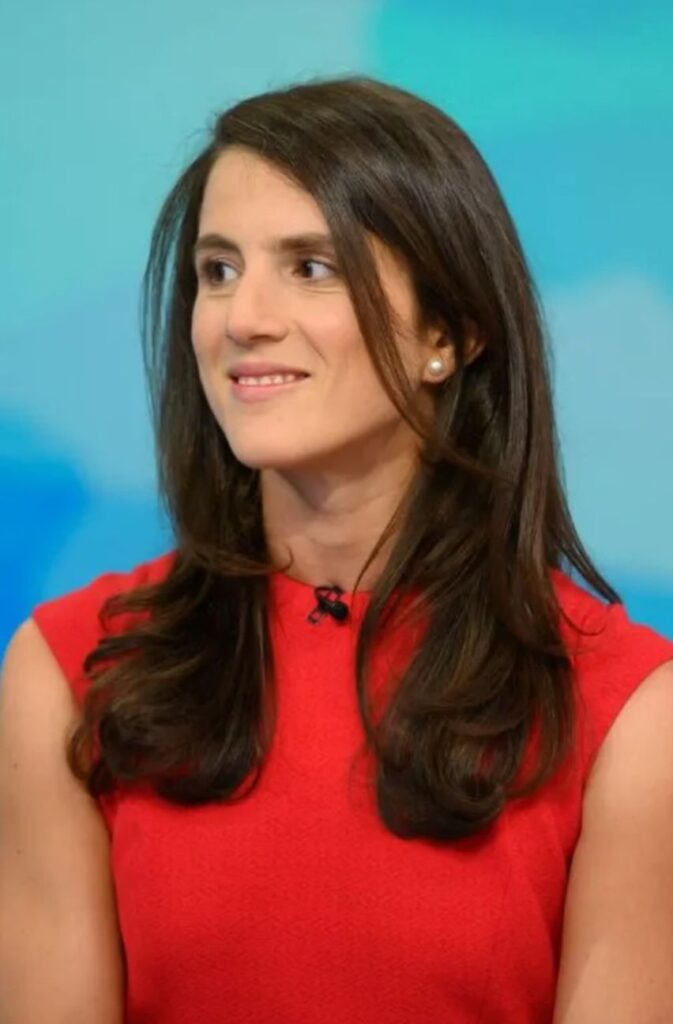
Tatiana Schlossberg — environmental journalist, author, and granddaughter of former President John F. Kennedy — has shared devastating news about her health. In a deeply personal essay published in The New Yorker, the 35-year-old revealed she has been diagnosed with terminal acute myeloid leukemia (AML), a rare and aggressive form of blood cancer.
Schlossberg wrote that doctors discovered the disease shortly after she gave birth to her second child, a daughter, in May 2024. It was a shocking and disorienting turn of events for someone who had always considered herself healthy and active.
“I had swum a mile in the pool the day before, nine months pregnant,” she shared. “I wasn’t sick. I didn’t feel sick. I was actually one of the healthiest people I knew.”
Her doctors identified not only AML but a rare genetic mutation known as Inversion 3 — an anomaly found in fewer than 2% of AML cases. The mutation often correlates with poor outcomes, something Schlossberg confronted with astonishing honesty in her essay.
Over the past year, she has endured multiple rounds of chemotherapy, two bone marrow transplants, and enrollment in two experimental clinical trials. Complications included a severe Epstein-Barr virus infection that damaged her kidneys and forced her to relearn how to walk.
Despite aggressive treatment, her doctors recently delivered the news she feared most: her cancer is no longer responding.
“During the latest clinical trial, my doctor told me he could keep me alive for a year, maybe,” she wrote.
Schlossberg is the second daughter of former U.S. Ambassador Caroline Kennedy and designer Edwin Schlossberg. She and her husband, George Moran, are raising a 3-year-old son and a 1-year-old daughter — children she now faces the possibility of leaving far too soon.
Her siblings, filmmaker Rose Schlossberg and Jack Schlossberg — who recently launched a run for Congress — have stepped in to share parenting responsibilities during her long hospitalizations. Their support, she says, has been unwavering.
“They have held my hand unflinchingly while I have suffered,” she wrote. “Trying not to show their pain and sadness in order to protect me from it.”
Schlossberg also acknowledged the surreal experience of undergoing cancer treatment while her cousin, Robert F. Kennedy Jr., was sworn in as Secretary of Health and Human Services. She wrote candidly that his controversial political actions, including an independent presidential run, deeply embarrassed her and her immediate family.
Adding to the uncertainty, the hospital where she was receiving treatment — NewYork-Presbyterian/Columbia University Irving Medical Center — briefly faced the loss of federal funding under the Trump administration. She described the fear she felt as the institution’s future hung in the balance, threatening the care she relied on.
In one of the essay’s most emotional reflections, Schlossberg expressed sorrow over adding to the Kennedy family’s long history of loss — including the assassinations of her grandfather, President John F. Kennedy, and her great-uncle Robert F. Kennedy.
“For my whole life, I have tried to be good… and to protect my mother,” she wrote. “Now I have added a new tragedy to her life, to our family’s life, and there’s nothing I can do to stop it.”
Tatiana Schlossberg’s essay is not only a medical journey but a portrait of resilience, fear, and profound love for her family. By choosing to write openly about her diagnosis, she has given the public a rare and deeply human glimpse into the private struggles behind a name often associated with history, politics, and public service.