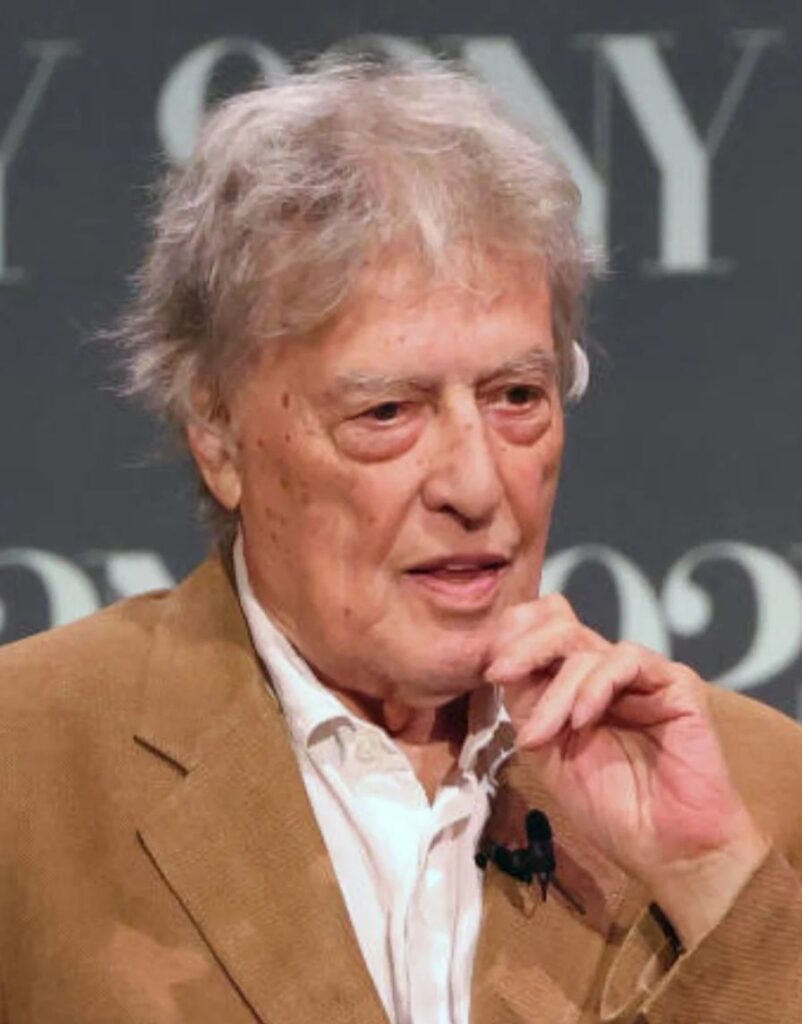
Tom Stoppard was born as Tomáš Sträussler on July 3, 1937, in Zlín — then part of Czechoslovakia. As a Jew in Europe on the eve of war, his childhood was upheaved by the rise of Nazism. When the Germans invaded in 1939, his family fled to Singapore. Later — as Japanese forces threatened Singapore — he, his brother, and their mother escaped to India. His father, who remained behind and served as a doctor, perished during the war. In 1946, his mother remarried a British army major, taking the name Stoppard, and the family moved to England.
Growing up in England, Stoppard left formal schooling at 17 and began working as a journalist — first in Bristol as a feature writer and drama critic. It was only later that he turned to theater: his first television play appeared in the early 1960s, and by 1966 he had written what would become his breakthrough — a stage play that would make his name.
From Journalism to Genius on Stage and Screen
That breakthrough came with Rosencrantz and Guildenstern Are Dead — a daring, absurdist and deeply playful reimagining of Shakespeare’s Hamlet, told from the perspective of two minor courtiers. Its first staging (in the mid-1960s) turned heads, and by 1967 it had moved to the repertory of what would become one of Britain’s leading theatres — marking the rise of Stoppard as a major playwright.
Over the next decades, he would pen more than thirty plays — often combining linguistic brilliance, philosophical depth and theatrical inventiveness. Among his major works are The Real Thing (1982) — a meditation on love, infidelity and art; Arcadia (1993) — a play that contrasts Romantic ideas and modern mathematical-scientific thought; and The Coast of Utopia, a sweeping 19th-century epic staged in multiple parts, exploring Russian emigre intellectual life.
But Stoppard was not limited to theatre. He also wrote radio plays, television dramas, and numerous screenplays — often for major films. Among his screen-writing credits are the dystopian film Brazil (1985), the wartime drama Empire of the Sun (1987), and much later a triumphant turn with Shakespeare in Love (1998), for which he won an Academy Award.
In many respects, Stoppard was a “writer’s writer” — his command of language and structure as precise as a craftsman’s, his plays often intellectual but rich with humanity and emotional complexity.
Late Discoveries, Renewed Voices — Identity and Memory
Despite his success, Stoppard never forgot his roots — and only later in life began to confront fully the weight of his heritage. Though raised British from childhood, he discovered after his mother’s death that much of his extended family had perished in the Holocaust.
That heritage found its powerful expression in his later work, most notably in the play Leopoldstadt (2020), which traces the fortunes of a Jewish family in Vienna from the early 20th century through the Holocaust and beyond. Through such works, Stoppard confronted history, memory and identity — transforming personal, painful truths into art that resonated with many.
He was honoured repeatedly: five major Best-Play awards on Broadway (the Tony Award for Best Play, for Rosencrantz and several others), stage and film accolades, and a knighthood in 1997 for his contributions to literature.
Final Curtain — A Quiet Farewell, a Loud Legacy
On November 29, 2025, Stoppard died peacefully at his home in Dorset, England — surrounded by his family, according to his representatives. In a brief statement, his agents said he would be remembered for “his brilliance and humanity, his wit, his irreverence, his generosity of spirit and his profound love of the English language.”
He leaves behind a body of work that — for countless theatre-goers, readers and filmmakers — offered laughter and reflection, intellect and emotion, memory and invention.
For those who care about the power of words, the slippery intersections of comedy and tragedy, and the ability of art to shape how we see ourselves and our history — Tom Stoppard’s voice, even now, speaks.
Why He Mattered and Will Be Remembered
Because few dramatists combined intellectual daring with theatrical flair as gracefully: his plays challenged audiences even as they entertained.
Because he translated his life — from exile and loss to assimilation and artistic triumph — into universal stories about identity, displacement, love, and memory.
Because he never limited himself: from plays to radio to film, from comedy to tragedy to historical drama, he proved the breadth of what a writer can be.
Because he believed in the power of language: wit, wordplay, philosophical exploration — all laced with humanity.
In a world often flattened by clichés and quick entertainment, Tom Stoppard reminded us of the art of thought, of nuance, and of words. His death is a solemn moment — but his work remains, timeless.