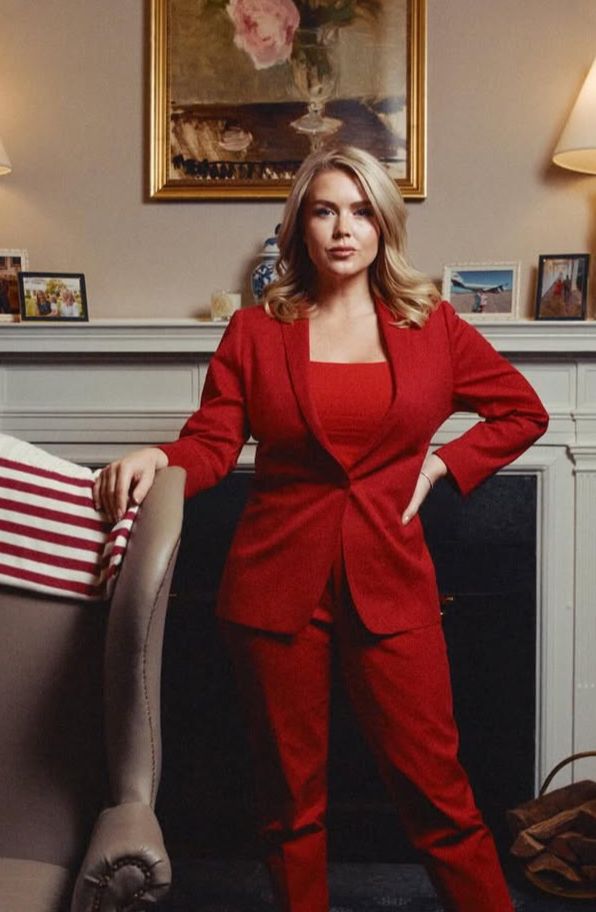
A Vanity Fair profile that was already getting plenty of attention has sparked a fresh round of discussion — not because of its reporting, but because of how it was promoted on social media. An Instagram post shared by the magazine, featuring an extreme close-up of White House Press Secretary Karoline Leavitt, quickly became the center of online debate.
The image, posted to Vanity Fair’s official account, zooms in so tightly that every detail of Leavitt’s face is on display. Skin texture, pores, and subtle lines around her lips stand out far more than they typically would in a standard portrait. Almost immediately, viewers began questioning the intent behind the photo, with many zeroing in on the area around her mouth.
Comment sections filled rapidly. Some users bluntly asked whether the marks around her lips were signs of cosmetic fillers, while others suggested the shot was carefully chosen to provoke exactly this kind of reaction. “That first photo feels calculated,” one commenter wrote. Another added that the close-up seemed intentionally exaggerated, calling it “quietly hilarious” and applauding the magazine for its bold visual choice.
The response has also revived ongoing conversations about the so-called “Mar-a-Lago face,” a term critics often use to describe a polished, highly stylized look associated with figures in Donald Trump’s inner political circle. Vanity Fair’s decision to describe Leavitt as a “mouthpiece” in the accompanying article only added fuel to the fire, with some readers interpreting the wording and the image together as a subtle jab at her appearance.
The renewed attention also brings back memories of Trump’s own remarks about Leavitt, particularly his repeated focus on her lips and speaking style. At a recent rally in Pennsylvania, Trump praised his press secretary before straying from his prepared remarks to comment on her on-camera presence.
“When she goes on television with that beautiful face and those lips that don’t stop — op-op-op — like a machine gun,” he said, complete with sound effects that many viewers later criticized as awkward and unnecessary.
Trump made similar comments earlier this year during an interview with Newsmax, once again highlighting Leavitt’s looks while calling her the best press secretary he’s ever had. While he framed his remarks as compliments, critics have argued that such comments place unnecessary emphasis on appearance rather than professional ability — the same issue now being debated online.
So far, neither Vanity Fair nor Leavitt has publicly responded to the reaction surrounding the Instagram post. Still, the moment serves as another example of how editorial decisions — especially in high-profile political coverage — can take on a life of their own once they hit social media.
As the conversation continues, the episode underscores a familiar truth of today’s media landscape: sometimes, a single image can spark far more controversy than the story it was meant to support.